Loading...
Macro TrackingPublished 2026-02-12
A Practical Guide to Using a Macro Calculator for Weight Loss
L
Lilbite Team
Lilbite editorial team
Think of a macro calculator as the secret weapon that finally ends the cycle of restrictive dieting. Instead of just guessing, it gives you a clear, data-driven path to results by calculating the exact amounts of protein, carbs, and fats your body needs to lose weight in a way that actually lasts.
This means you get full control over your food choices.
Your Secret Weapon for Sustainable Weight Loss
Forget about those vague diet plans and the frustration that comes with them. A macro calculator for weight loss brings the clarity you need to get predictable, sustainable results. It completely changes the game, turning nutrition from a chore into a powerful tool. You stop hoping for the best and start knowing exactly what your body needs to succeed.
That shift in mindset is huge. Instead of being stuck with rigid meal plans that never quite fit your life, you gain the freedom to make smart decisions about the food you eat. This is the whole idea behind "If It Fits Your Macros" (IIFYM)—a flexible approach that lets you enjoy foods you genuinely love while still hitting your fat loss goals. You’re no longer just following a diet; you're designing your own nutrition plan.
From Guessing to Knowing
Let's be honest, most traditional diets fail because they're built on rough estimates and restrictions, not on what your body actually needs. A macro calculator for weight loss cuts through all that noise. It takes your unique details—like age, weight, activity level, and goals—and turns them into a simple, actionable blueprint for your daily meals.
This data-first approach has some serious advantages:
- You're in control: You finally understand the why behind your food choices, which builds a ton of confidence.
- It’s flexible: As long as you hit your macro targets, no food is off-limits. This is key for avoiding that feeling of deprivation that leads to burnout.
- You build lasting habits: By learning what your body truly needs, you’re not just on a short-term diet. You’re building habits for life.
The Rise of Smart Nutrition Tools
It's clear people are tired of one-size-fits-all advice. The global weight management market was valued at a massive USD 400.8 billion in 2024 and is expected to hit nearly USD 896.5 billion by 2035. This boom shows a massive shift toward structured, data-backed health solutions. You can check out the full market projections on Future Market Insights to see just how big this trend is. It’s why tools like a macro calculator have become so essential for anyone serious about their health.
By focusing on macronutrients instead of just calories, you're not just managing weight—you're optimizing your body's performance, preserving muscle mass, and ensuring you have the energy to live an active life. It’s about nourishment, not just reduction.
Modern AI-powered tools are making this process easier than ever. For instance, the Lilbite app automates all the complicated calculations and takes the headache out of logging your food. With features like photo-based tracking and an AI assistant, your phone basically becomes a personal nutrition coach, giving you smart insights to guide your choices in real-time. This is the future of nutrition: a smarter, more intuitive way to fuel your body and crush your weight loss goals without all the hassle.
Nailing Down Your Body's True Energy Needs
Before you can use a macro calculator to lose weight effectively, you need to figure out your body's personal energy budget. It all boils down to two key numbers: your Basal Metabolic Rate (BMR) and your Total Daily Energy Expenditure (TDEE).
Think of BMR as your "coma calories"—the baseline energy your body needs just to keep the lights on. It’s what you burn powering your organs, breathing, and repairing cells, even if you do nothing but rest all day.
TDEE is the whole story. It takes that baseline BMR and adds in every calorie you burn through daily movement, whether that’s walking to the fridge or crushing a high-intensity workout. This number is your true starting line for any weight loss plan because it reflects what you actually burn in the real world.
The Foundation: Your BMR
First things first, you have to understand What is Basal Metabolic Rate to grasp how your daily calorie needs are built. Your BMR isn't some generic number; it's unique to you, shaped by a few key personal details.
Here’s what goes into calculating it:
- Age: Our metabolism naturally slows down as we get older, so BMR tends to drop a bit over time.
- Sex: Men generally carry more muscle mass and less body fat than women of the same weight and age, giving them a slightly higher BMR.
- Weight and Height: Simply put, a larger body requires more energy to run, so a higher weight and height mean a higher BMR.
These factors come together to create a baseline calorie number that is totally specific to your body. While you can crunch the numbers yourself, it’s the essential first step in understanding your energy equation.
From Rest to Real Life: Your TDEE
Once your BMR is set, it's time to factor in your lifestyle. This is where your activity level enters the picture, turning your resting metabolism into your TDEE. Be honest here—this single input can dramatically shift your daily calorie needs, and getting it right is crucial.
Let’s look at a quick example. Imagine Alex, a 35-year-old office worker who weighs 180 pounds. His BMR comes out to around 1,750 calories. That's the energy he’d burn lying in bed all day.
But Alex isn't just sitting around. He hits the gym three times a week and walks his dog every night, making him "lightly active." When we apply that activity multiplier (1.375) to his BMR, his TDEE shoots up to about 2,400 calories. That's an extra 650 calories burned each day just by moving.
If Alex started training for a half-marathon and became "very active," his TDEE could easily climb past 3,000 calories.
The table below shows just how much that activity multiplier matters, using our example BMR of 1,750 calories.
How Activity Level Impacts Your Daily Calorie Needs
| Activity Level | Multiplier | Example Daily Calories (TDEE) |
|---|---|---|
| Sedentary | **1.2** | **2,100 calories** |
| Lightly Active | **1.375** | **2,406 calories** |
| Moderately Active | **1.55** | **2,713 calories** |
| Very Active | **1.725** | **3,019 calories** |
As you can see, the difference between a sedentary day and a very active one is over 900 calories—a massive gap that can make or break your weight loss progress.
This whole process is about moving from guesswork to having a clear, data-driven plan. That's how you build habits that actually stick.
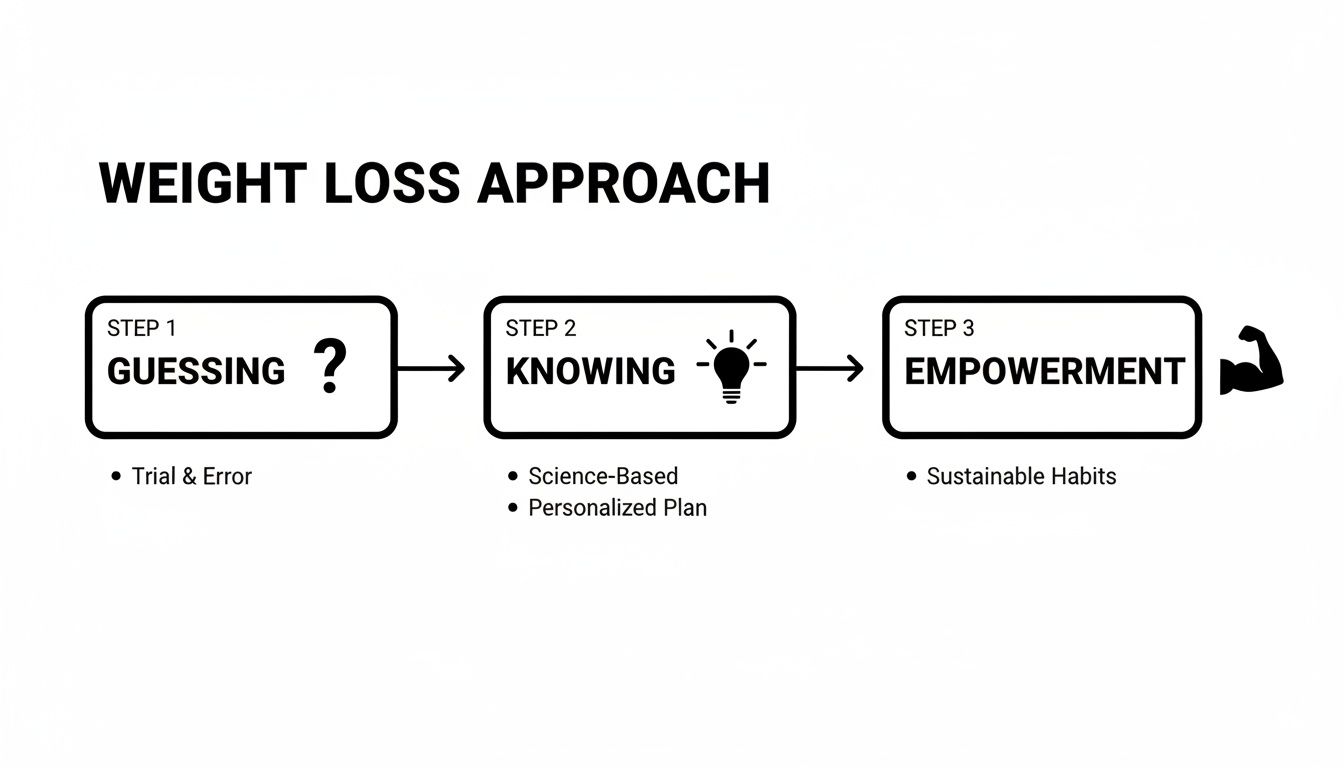
Knowing your numbers is what empowers you to make real, lasting changes.
Key Takeaway: Your TDEE is a living number, not a static one. It reflects your real life. Small, consistent tweaks to your activity can have a huge impact on your total calorie burn, giving you way more flexibility with your food.
Figuring this all out is powerful, but you don't have to do all the math on your own. For an effortless way to find your starting point, check out our free TDEE calculator. Just plug in your details, and it'll do the heavy lifting for you, giving you an accurate, personalized energy baseline. It cuts out the guesswork so you can focus on what really matters—fueling your body right.
Creating a Smart and Sustainable Calorie Deficit
Once you've nailed down your Total Daily Energy Expenditure (TDEE), you know your maintenance calories—your nutritional starting line. The next step is to create a calorie deficit, which is the fundamental engine that drives fat loss.
But this isn't about slashing calories to the bone. The real art is finding that sweet spot where your body burns stored fat for fuel without draining your energy, tanking your workouts, or sacrificing hard-earned muscle.
The weight loss industry is a behemoth, valued at USD 165.10 billion in 2025 and projected to hit USD 295.09 billion by 2032. It's telling that a massive 50.2% of this market comes from nutrition plans and supplements. This tells us one thing loud and clear: people want straightforward, non-invasive solutions that fit into their real lives. It's exactly why using a digital macro calculator for weight loss has become such a go-to strategy. You can dig into the trends shaping the weight management market to learn more.
The Dangers of an Aggressive Deficit
It’s incredibly tempting to chase the fastest results possible by creating a huge calorie deficit, often around 20-25% below your maintenance TDEE. While this can definitely make the scale drop quickly at first, it's a strategy that almost always backfires.
Let's look at a classic real-world example. John was pumped to lose weight fast, so he cut his calories from a TDEE of 2,700 down to 2,000 per day—a steep 25% deficit. The first week felt great, and the scale moved. But by week three, he was constantly drained, irritable, and obsessed with food. His gym sessions became a grind, and he eventually burned out, leading to a weekend binge that undid his progress and left him feeling completely defeated.
This is a classic trap. An overly aggressive deficit can trigger a cascade of negative effects:
- Intense hunger and cravings that make sticking to your plan feel like a constant battle.
- Metabolic adaptation, where your body panics and slows down your metabolism to conserve energy.
- Muscle loss, because your body starts breaking down metabolically active muscle tissue for fuel.
- Rebound weight gain, which almost inevitably follows a period of extreme restriction.
The Power of a Moderate and Sustainable Approach
Now, let's consider Maria. Her TDEE was 2,200 calories. Instead of making a drastic cut, she opted for a moderate deficit of 15%, which put her daily goal at a much more manageable 1,870 calories.
The weight came off a bit slower than John's at the start, but her journey was worlds apart. She had plenty of energy for her workouts, felt satisfied after her meals, and had the flexibility to enjoy a dinner out with friends without feeling like she’d derailed her entire week. Her plan was sustainable, so she actually stuck with it, losing weight consistently and building habits that lasted.
Key Takeaway: The goal isn't just to lose weight; it's to achieve sustainable fat loss. A moderate deficit of 10-15% is almost always the smarter long-term play. It respects your body's needs, helps preserve muscle, and makes the journey enjoyable enough to see through to the end.
This is where the "If It Fits Your Macros" (IIFYM) philosophy really comes into its own. A moderate deficit gives you enough caloric runway to include foods you genuinely love, which is the secret sauce for long-term success. No foods are off-limits, as long as they fit within your daily targets.
This approach helps you avoid the burnout and all-or-nothing mindset that derails so many diets. Instead of feeling restricted, you feel empowered to make smart choices that align with both your goals and your lifestyle.
To avoid the common pitfall of cutting calories too deep, a specialized tool can be a game-changer. Using a smart tool takes the guesswork out of finding your ideal starting point. You can get a personalized recommendation with our Calorie Deficit Calculator, which is designed to set a target that is both effective and sustainable.
Setting Your Macros for Optimal Results
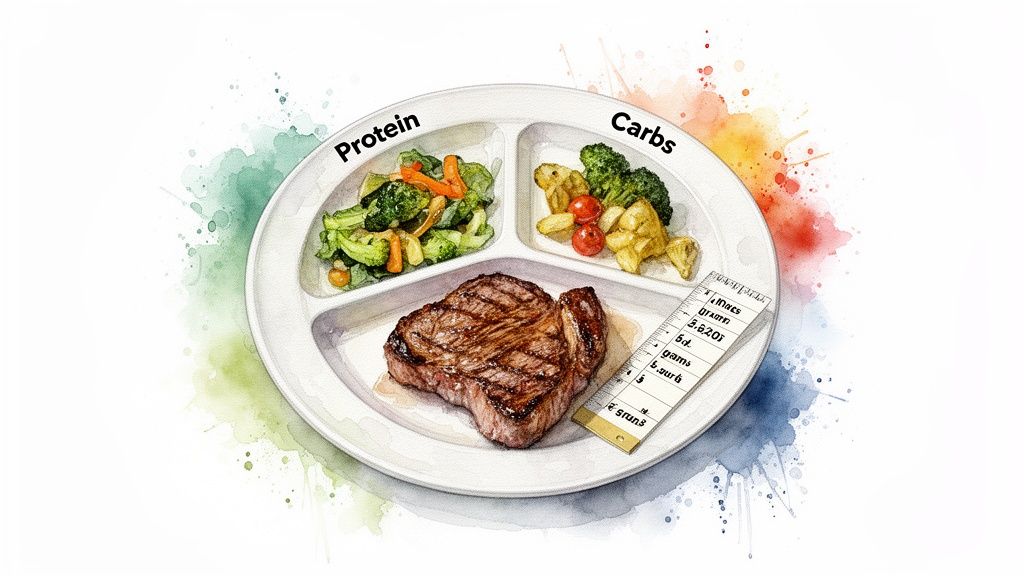
Alright, you’ve got your calorie target. Now for the fun part—deciding how to spend those calories. This is where we move past basic calorie counting and into the art of structuring your macros: protein, carbs, and fats.
Think of it this way: your calorie goal is the budget, but your macros are the spending plan. A smart plan gets you better results, faster. It's not just about the numbers; it's about the strategy behind them, which is the key to truly mastering macros for weight loss.
Not all calories are created equal, and how you split them up will make a huge difference in your energy, hunger levels, and body composition.
Prioritize Protein, Always
If you only get one thing right, make it protein. When you’re in a calorie deficit, protein is your absolute best friend, and it's the first number you should lock in with a macro calculator for weight loss.
Why the big focus? First off, protein keeps you full. Seriously full. A high-protein meal crushes hunger pangs for hours, which is a massive win when you’re trying to stick to a deficit. No more mindless snacking.
Second, your body burns more calories just digesting protein than it does for carbs or fats. This is known as the Thermic Effect of Food (TEF), and it gives your metabolism a nice little bump.
Most importantly, getting enough protein is non-negotiable for protecting your hard-earned muscle. When you lose weight, you want it to be fat, not muscle. A high-protein diet tells your body to burn fat for fuel while preserving the lean tissue that keeps your metabolism humming.
Here’s a solid rule of thumb for your protein target:
- For fat loss & muscle preservation: Aim for 0.8 to 1.2 grams of protein per pound of your goal body weight.
- For example: If your goal is 150 lbs, your daily protein target should be between 120 and 180 grams.
Hitting this number consistently makes dieting feel a whole lot easier and ensures the weight you're dropping is the kind you want to lose.
Splitting Your Carbs and Fats
Once your protein is set, subtract those calories from your daily total. The calories you have left are for carbs and fats. How you divide them is less about right or wrong and more about what works for you, your lifestyle, and your preferences.
Let's look at a few ways to approach this.
The Higher-Carb Approach
This is a fantastic option if you’re active and hit the gym regularly. Carbs are your body's go-to fuel source for high-intensity work.
- Who it’s for: People who lift heavy, runners, or anyone who just feels more energetic and performs better with more carbs.
- How it works: Carbs refill your muscle glycogen stores, which powers your workouts and helps you recover. This split helps you keep your training intensity up, even in a deficit.
The Higher-Fat Approach
On the flip side, some people thrive on a higher fat intake. Healthy fats digest slowly, which can lead to more stable energy levels and better appetite control throughout the day.
- Who it’s for: Those who are less active, prefer foods like avocados, nuts, and olive oil, or tend to feel sleepy after a carb-heavy meal.
- How it works: This approach can really help with satiety between meals and is a common setup for lower-carb or ketogenic-style diets.
To give you a clearer picture, here’s how different splits might look for someone eating 2,000 calories a day.
Sample Macro Splits for a 2000-Calorie Diet
This table shows a few common ways to divide your macros. Notice how the protein stays relatively high in all three, while the carbs and fats are adjusted based on the dietary approach.
| Approach | Protein (g) | Carbohydrates (g) | Fats (g) |
|---|---|---|---|
| **Balanced** | 150 (30%) | 200 (40%) | 67 (30%) |
| **Higher-Carb** | 150 (30%) | 250 (50%) | 44 (20%) |
| **Higher-Fat / Lower-Carb** | 150 (30%) | 100 (20%) | 111 (50%) |
As you can see, there's more than one way to structure a diet. The "best" one is simply the one that makes you feel good and that you can stick with consistently.
Don't be afraid to experiment. Try one split for a week or two. Pay attention to your energy, your performance in the gym, and your hunger levels. If it’s not working, switch it up. The perfect macro split for you is the one you can live with long-term.
Feeling a bit lost? This is where an AI-powered tool like the Lilbite app can be a huge help. You can ask it things like, "What are some high-protein, low-calorie snacks?" and get instant ideas that fit your numbers. If you just want to get your initial targets calculated, our built-in https://lilbite.app/tools/macro-calculator is the perfect place to start.
Putting Your Plan into Action with AI Tracking
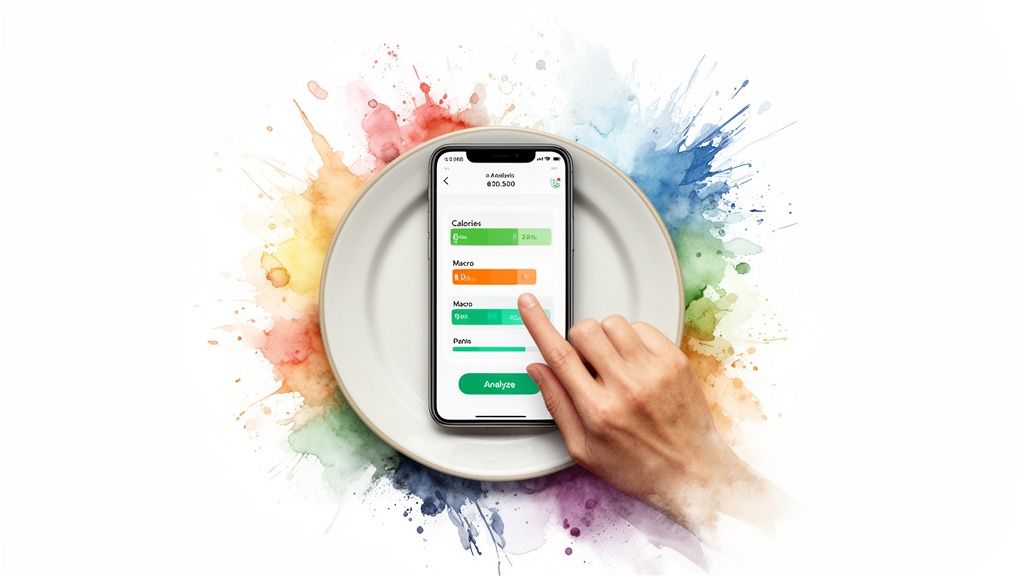
Alright, you've crunched the numbers with the macro calculator and have a solid plan. So, now what? This is the moment of truth—bridging the gap between the numbers on your screen and the food on your plate.
Honestly, this is where most people get tripped up. The daily chore of logging every single thing you eat can quickly drain your motivation. Even the most perfectly calculated macro plan is totally useless if you don't actually follow it.
Consistency is the name of the game. Thankfully, you don't have to do it all by hand anymore. Modern tech is making the whole tracking process so much easier, turning those numbers into habits that actually stick.
Make Tracking Effortless with AI
Imagine logging your entire lunch without typing a single word or scrolling through an endless food database. That’s not science fiction; it's what AI-powered tools like the Lilbite app are doing right now. The biggest obstacle to consistent tracking has always been the sheer effort involved.
Lilbite’s 'Snap & Analyze' feature was built for real life, not a laboratory. You just snap a picture of your meal, and the AI does the heavy lifting.
- It identifies the foods on your plate, from the grilled chicken down to the broccoli florets.
- It estimates portion sizes with surprising accuracy.
- It gives you an instant calorie and macro breakdown, logging it for you automatically.
Just like that, the number one excuse for falling off the wagon is gone. It makes logging a meal as fast as posting a story on Instagram, which means you're far more likely to do it day in and day out.
From Simple Logger to Nutrition Coach
A good tracking app is more than just a digital food diary. It should give you insights that help you make better choices. This is where AI really begins to shine, acting like a personal nutrition coach that actually understands your goals.
Instead of just spitting numbers back at you, Lilbite provides context. Its 'AI Nutrition Level' is a smart score it gives every meal you log. It tells you instantly how well that meal aligns with your fat loss targets, which is a fantastic way to learn what a "good" plate of food actually looks like for you.
It’s been shown time and time again—a study in the Journal of the American Dietetic Association confirmed that consistent self-monitoring is one of the biggest predictors of long-term weight loss. AI simply removes the friction that stops most people from being consistent.
Get Instant Answers with an AI Assistant
What if you had a nutrition expert in your pocket, ready to answer questions on the spot? That’s exactly what the 'Talk to AI' feature feels like.
Think about these real-world situations:
- You're out to eat and wondering, "Is this salmon dish a good choice for my fat loss goal?"
- You're at the grocery store comparing two products: "Compare the macros in chicken thighs vs. breast."
- You're staring into the fridge at dinnertime and need inspiration: "What can I eat to hit my protein target without going over my calories?"
You get an immediate, helpful answer that’s specific to your situation. This turns tracking from a passive chore into an active learning process. You start to understand the why behind your food choices, building the kind of nutritional intuition that leads to lifelong success. This is how you make a macro calculator work for you in the real world.
Got Questions About Macro Tracking? Let's Clear Things Up.
Even with the perfect macro calculator, you're bound to have some questions once you start putting your numbers into practice. That's totally normal. Most people do.
Let's walk through some of the most common hurdles people face. Getting these sorted out will give you the confidence to handle any little bumps in the road and stick with your plan for the long haul.
How Often Should I Recalculate My Macros?
Your body is constantly adapting, so your macro targets can't be set in stone. One of the biggest mistakes I see is people sticking to their original numbers for months on end, even after dropping a significant amount of weight. As you get leaner, your body simply doesn't need as much energy, which means your TDEE will go down.
A good rule of thumb is to recalculate your macros after every 10-15 pounds of weight loss. This simple adjustment keeps your calorie deficit in the sweet spot and prevents your progress from stalling out.
Speaking of stalling, if the scale hasn't budged for two or three weeks despite you being consistent, that's your cue. It's time to run the numbers again.
Another key time for a recalculation is any major shift in your lifestyle.
- Starting a new workout routine: If you go from walking a few times a week to hitting the weights four days a week, your energy needs will definitely change.
- Changing jobs: Swapping a desk job for something more active (or the other way around) has a huge impact on your daily calorie burn.
This is where smart tools like the Lilbite app are a huge help. You just pop in your new weight or activity level, and it instantly spits out your adjusted targets. No guesswork needed.
What if I Go Over My Macros for One Day?
This is a big one, and the answer is simple: don't sweat it. One day of eating more than you planned will not undo weeks of hard work.
The absolute worst thing you can do is slip into that "all-or-nothing" mindset, where one off-plan meal makes you feel like the whole week is a write-off. It's not.
Progress is built on consistency over time, not perfection every single day. If you have a high-calorie day, just acknowledge it and get right back on track with your very next meal. Whatever you do, don't try to "make up for it" by drastically under-eating the next day. That's a fast track to a miserable cycle of restriction and binging.
Your weekly average matters far more than any single day's numbers. Think of your calories like a weekly budget. If you overspend a bit on a Tuesday, you can still easily finish the week strong by staying the course. This flexibility is what makes tracking sustainable.
Should I Track Net Carbs or Total Carbs?
For the vast majority of people just looking to lose weight, tracking total carbohydrates is the way to go. It's straightforward, easy to manage, and delivers incredible results when you're also hitting your protein goals and staying in a calorie deficit.
Net carbs—which is just total carbs minus fiber—is really only a concern for people following very specific diets like keto. The goal there is to keep the body's insulin response as low as possible.
Unless a keto diet is your specific plan, there’s no need to overcomplicate things. Focus on your total carb number. It will give your body the fuel it needs for workouts and daily energy without adding unnecessary confusion to your tracking.
Can I Build Muscle While Losing Fat?
Yes, you absolutely can! It's often called "body recomposition," and it’s a realistic goal for a few groups of people in particular:
- You're new to lifting: When you first start resistance training, your body is primed to build muscle, even in a calorie deficit. These are your "newbie gains."
- You're coming back from a break: If you used to train hard but took a long time off, your body can regain that lost muscle surprisingly quickly thanks to muscle memory.
To pull this off, two things are non-negotiable. First, you need to eat a lot of protein—we're talking in the range of 1.6 to 2.2 grams per kilogram of body weight. This gives your body the raw materials for muscle repair. Second, you have to be consistent with a challenging strength training program.
Your calorie deficit also needs to be moderate, not massive. A slight deficit gives your body enough energy to fuel your workouts and build new muscle while still tapping into fat stores. This is where a macro calculator becomes essential, letting you lock in that high protein target while keeping your calories perfectly dialed in.
Ready to stop guessing and start seeing real results? The Lilbite app combines a powerful AI macro calculator with effortless tracking to give you a clear path to your weight loss goals. Download it today and take control of your nutrition. Get Lilbite on the App Store.
Enhanced by the Outrank app