Your Guide to Using a Body Fat Percentage Calculator
Lilbite editorial team
A body fat percentage calculator is one of the smartest tools you can have in your fitness arsenal, offering a much clearer view of your progress than a traditional scale ever could. It cuts through the noise by separating fat from lean mass, giving you a true picture of your body composition.
Why Body Fat Percentage Matters More Than Weight
Staring at the number on the scale tells you only a tiny part of your health story. That single number lumps everything together—muscle, fat, bone, and water—which can be incredibly misleading.
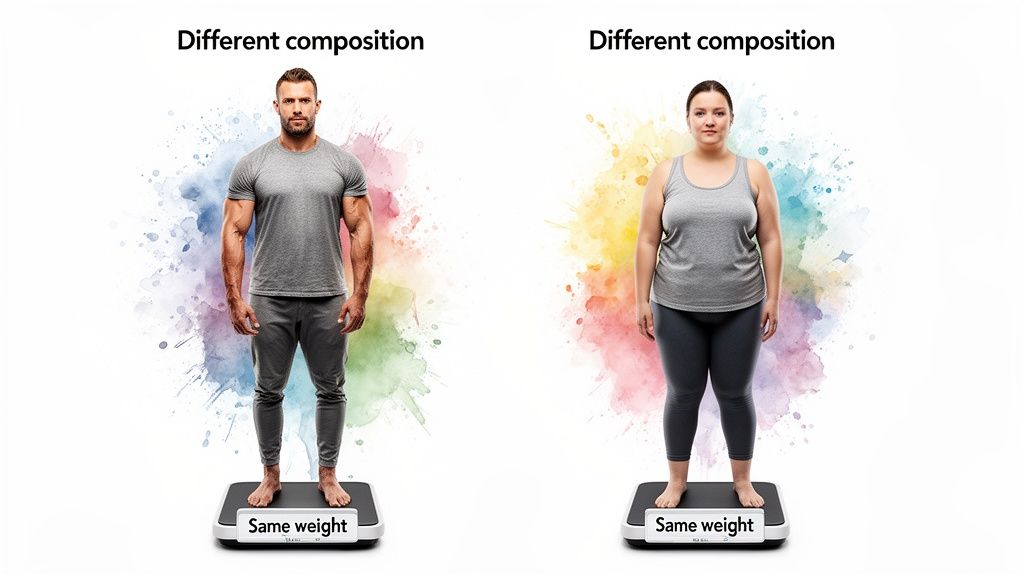
For example, imagine two people who are both 5'10" and weigh 180 pounds. One could be a lean, muscular athlete, while the other might have much higher body fat and less muscle, putting them at a greater health risk. They weigh the same, but their bodies are completely different.
This is exactly why understanding your body composition is so critical.
Body composition is simply the ratio of fat mass to lean mass (which includes muscle, bones, and organs). It's not about how much you weigh, but what that weight is actually made of. Shifting your focus from just "losing weight" to improving this ratio is the real key to long-term success.
Beyond the Bathroom Scale
Focusing only on your total weight can be a recipe for frustration. Let's say you start strength training. You'll likely build dense, lean muscle while losing fat at the same time. On the scale, your weight might not budge—or it could even go up a bit! This would make you think your hard work isn't paying off.
A body fat percentage calculator, however, would show you the amazing progress happening beneath the surface.
Tracking your body composition provides a far more accurate and motivating picture. It helps you:
- Set Smarter Goals: Instead of a vague goal like "lose 10 pounds," you can aim to reduce your body fat by 3%. That's a much more specific and meaningful target.
- Preserve Muscle Mass: When you're trying to lose fat, the last thing you want to do is lose precious muscle along with it. Monitoring your body fat helps ensure you’re holding onto lean tissue, which is essential for a healthy metabolism.
- Assess Health Risks: High body fat, especially the visceral fat that surrounds your organs, is linked to a higher risk of health problems like heart disease and type 2 diabetes. Body fat percentage is a much better indicator of these risks than your weight or even BMI. You can see how these metrics connect in our ideal weight calculator.
A More Meaningful Metric for Success
Think of your body like a car. The scale tells you the car's total weight, but your body fat percentage tells you how much of that is the powerful engine (muscle) versus the fuel in the tank (fat). You need some fuel, of course, but a bigger engine is what really drives performance.
By using a body fat percentage calculator, you can stop chasing a meaningless number and start focusing on what truly matters: building a stronger, leaner, and healthier body. This one metric gives you the context you need to set effective goals, whether you're aiming for fat loss, muscle gain, or peak athletic performance.
Understanding Healthy Body Fat Ranges
So you’ve got your number. What does it actually mean?
Think of your body like a high-performance car. Your muscle is the engine, burning fuel and getting you where you want to go. Body fat is the fuel in the tank. You absolutely need some to run, but carrying too much just weighs you down and hurts performance.
The first thing to get straight is that not all body fat is created equal. Your body relies on two different kinds.
Essential Fat vs. Storage Fat
Essential fat is exactly what it sounds like—the minimum amount your body needs to survive. It’s woven into your brain, nerves, bone marrow, and organs, playing a huge role in protecting your systems and regulating hormones. Trying to eliminate this is a terrible idea.
Storage fat, on the other hand, is the extra energy your body has packed away in adipose tissue. A little bit is useful for insulation and as a backup energy source, but too much is what leads to health complications. A body fat calculator is really designed to help you keep an eye on this type of fat.
Getting this distinction is crucial. The goal isn't to get rid of all fat; it’s about managing it within a healthy, functional range.
What Is a Healthy Body Fat Percentage?
So, what should you be aiming for? There's no single magic number. The ideal range shifts based on your gender, age, and how active you are. Women naturally need and carry more body fat than men, largely due to hormonal differences and the demands of childbearing.
After you pop your measurements into the Lilbite calculator, you'll see a result that looks something like this:
This visual instantly shows you where you land on the spectrum, from athlete to obese. It cuts through the noise and gives you a clear starting point without any guesswork.
Knowing this number is more important than ever. Worldwide adult obesity has more than doubled since 1990, jumping from around 8% to 16% by 2022 and affecting a staggering 890 million adults. This trend is exactly why tools like a body fat calculator have become so essential for anyone looking to set realistic health goals. You can learn more about these global obesity trends and their impact to understand the bigger picture.
Healthy Body Fat Percentage Ranges for Men and Women
To set a meaningful goal, you need some solid benchmarks. The chart below lays out the generally accepted body fat percentage ranges, giving you a clear reference for your own results.
Healthy Body Fat Percentage Ranges for Men and Women
| Category | Body Fat % (Women) | Body Fat % (Men) |
|---|---|---|
| **Essential Fat** | 10–13% | 2–5% |
| **Athletes** | 14–20% | 6–13% |
| **Fitness** | 21–24% | 14–17% |
| **Acceptable** | 25–31% | 18–24% |
| **Obese** | ≥32% | ≥25% |
So what do these categories actually look and feel like?
- Essential Fat: This is the bare minimum for your body to function. Dipping below this level is dangerous and definitely not a goal to strive for.
- Athletes: Think elite competitors. This range is defined by serious muscle definition and is typically the result of intense, consistent training.
- Fitness: This is where you’ll find people who are lean, healthy, and active. They often have visible abs and good muscle tone.
- Acceptable: Most healthy adults fall into this category. It's a range associated with good general health, even without being visibly "shredded."
- Obese: Being in this category significantly increases the risk for health issues like heart disease, type 2 diabetes, and other chronic conditions.
Key Takeaway: The goal isn't a race to the bottom. It’s about finding a sustainable range that feels good and aligns with your health, performance, and aesthetic goals.
Using these ranges, you can pinpoint where you are right now and set a realistic target. Instead of chasing some random number you saw online, you can build a personalized goal that moves you toward a stronger, healthier body composition.
How to Measure Your Body Fat Accurately
Alright, we've covered the "why" behind tracking body fat. Now let's get into the "how"—turning theory into real-world practice.
While there are plenty of high-tech methods out there, one of the most accessible and surprisingly reliable approaches is the U.S. Navy method. All you need is a simple tape measure and a good body fat percentage calculator.
Getting a number you can trust isn't just about plugging figures into a tool; it's about the quality of those figures. Consistency is everything here. Tiny variations in how you measure can throw off your results, so creating a repeatable process is the key to seeing a true trend over time.
Taking Your Measurements The Right Way
For the U.S. Navy formula, you only need a few key measurements. The spots differ slightly for men and women, which makes sense since we all tend to store fat in different places.
For Men, You'll Need:
- Neck: Wrap the tape around the fullest part of your neck, right below your Adam's apple.
- Waist: Measure horizontally around your abdomen, directly over your navel.
- Height: Measure your height without any shoes on.
For Women, You'll Need:
- Neck: Measure around the fullest part of your neck, just below the larynx.
- Natural Waist: Find the narrowest point of your torso. This is usually just above your belly button.
- Hips: Wrap the tape around the widest part of your hips and buttocks.
- Height: Measure your height without shoes.
Pro Tip: For the most reliable tracking, always measure under the same conditions. First thing in the morning—after you've used the restroom but before eating or drinking anything—is perfect. This simple habit minimizes daily fluctuations from food and hydration.
Ensuring Consistent and Accurate Results
Your technique matters more than you might think. A flimsy tape measure or pulling it too tight can easily skew your numbers and mess with your progress tracking.
To get it right every single time:
- Use a Flexible Tape: A soft, non-stretch measuring tape (the kind used for sewing) is ideal. Steer clear of metal construction tapes.
- Keep it Snug, Not Tight: The tape should lie flat against your skin without digging in or compressing it. A good rule of thumb is that you should be able to slide one finger between the tape and your body.
- Stay Relaxed: Don't suck in your stomach or flex your muscles. Just stand naturally and breathe normally to get a true snapshot of your body.
- Measure Twice (or Thrice!): Take each measurement two or three times and average the results. This helps confirm you've found the right spot and are applying consistent pressure.
Once you have these numbers, you can pop them into a digital body fat percentage calculator, like the one built into the Lilbite app. The tool does all the math for you in an instant, giving you a clear result to work with.
This flowchart helps visualize how we think about body fat—from the essential fat your organs need to survive, all the way to levels that can pose health risks.
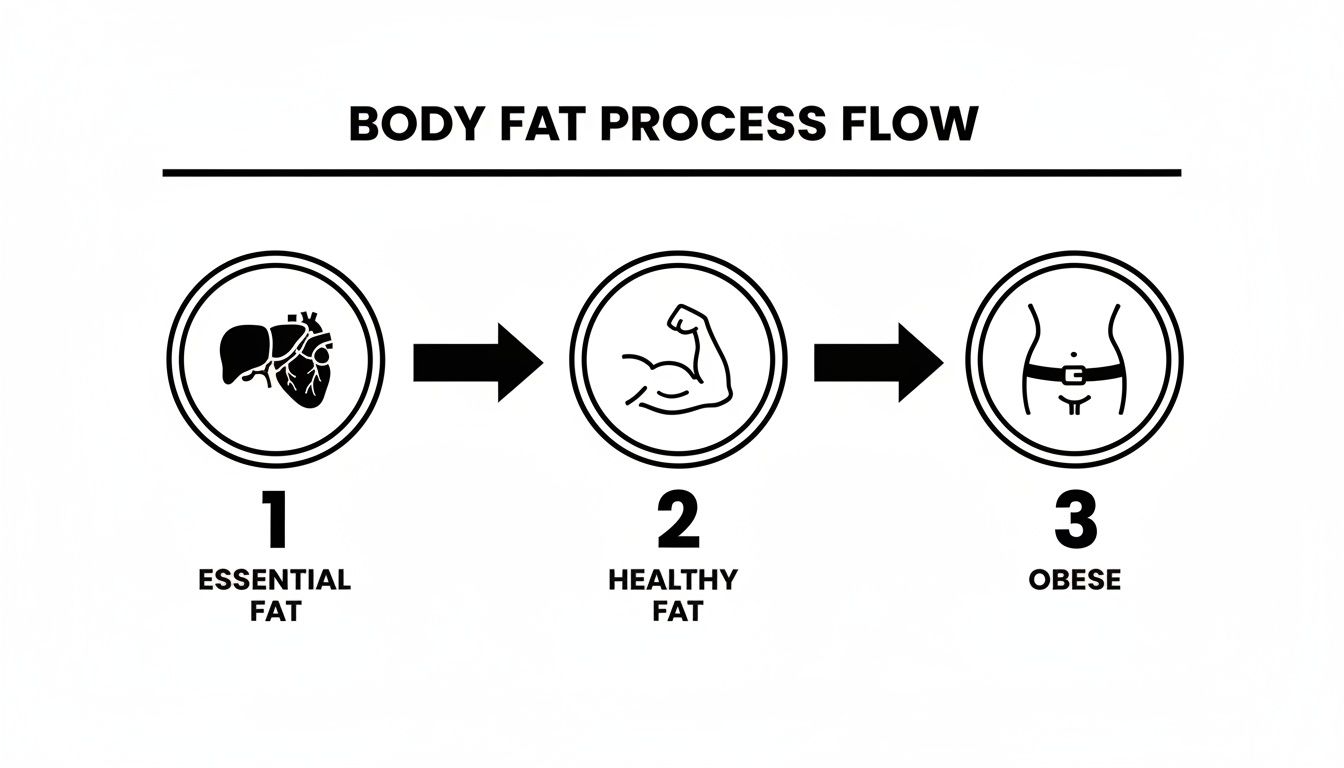
As you can see, the goal is never to eliminate body fat completely. It's about finding that healthy balance for both how you look and how your body functions.
Other Common Measurement Methods
The tape measure method is fantastic for tracking progress at home, but it's good to know about other options you might come across. Each has its own pros and cons when it comes to accuracy, cost, and convenience.
Skinfold Calipers
- How it Works: This little tool pinches the subcutaneous fat (the fat right under your skin) at a few specific sites on your body. The measurements are plugged into a formula to estimate your total body fat.
- Pros: Very cheap, and it can be quite accurate when done by someone who knows what they're doing.
- Cons: There’s a serious learning curve. It’s incredibly easy to get inconsistent results if your technique isn't spot-on every time.
Bioelectrical Impedance Analysis (BIA) Scales
- How it Works: You’ve probably seen these. They send a tiny, harmless electrical current up through your body. Fat and muscle conduct electricity differently, and the scale uses this resistance (impedance) to guess your body composition.
- Pros: Super easy and fast to use at home. Just step on the scale.
- Cons: The results can be all over the place. Your hydration level, whether you just ate, or if you recently worked out can dramatically swing the numbers from one day to the next.
DEXA Scan (Dual-Energy X-ray Absorptiometry)
- How it Works: This is the gold standard in a clinical setting. You lie on a table while a low-dose X-ray machine scans you, precisely measuring fat mass, lean mass, and even bone density.
- Pros: The most accurate method out there, giving you incredibly detailed data.
- Cons: It’s expensive, and you have to book an appointment at a specialized clinic to get it done.
For most of us, the tape measure method hits the sweet spot. It offers the perfect blend of accessibility, affordability, and reliability for tracking your progress over time. It might not have the pinpoint precision of a DEXA scan, but when you do it consistently, it gives you exactly what you need: the directional data to know if your plan is working.
What's the Math Behind These Calculators?
Ever wondered what’s happening "under the hood" when you punch your numbers into a body fat percentage calculator? You definitely don’t need a math degree to get it. The easiest way to think about these formulas is like using different camera lenses—each one is designed to capture a slightly different view of the same subject.
Some formulas, like the ones that lean on BMI, are the wide-angle lens of the group. They give you a broad, general estimate that works okay for large populations. Others, like the popular U.S. Navy method, are more like a zoom lens, using specific measurements of your body to zero in on a more refined picture. Each one uses a different set of inputs to guess at your body composition, and knowing how they work helps you understand the number you get back.
And these tools are more important than ever. Global obesity rates are projected to hit 24% by 2035, a huge jump from 14% back in 2020. That means over half of all adults could soon be overweight or obese. This is exactly why a good body fat percentage calculator is so much more useful than just looking at BMI, which famously can’t tell the difference between a muscular athlete and a sedentary person of the exact same weight. You can read the full report on these global health projections on worldobesityday.org.
The U.S. Navy Method
One of the most trusted and widely used formulas out there is the U.S. Navy method. It was developed by the Naval Health Research Center and relies on simple circumference measurements—the kind you take with a basic tape measure—to estimate your body fat. Its biggest advantage is that it’s non-invasive and incredibly accessible. All you need is a tape measure.
The whole idea is that by measuring specific spots where people tend to store fat, you can get a surprisingly reliable estimate of your total body fat.
- For Men: The formula requires your height, neck circumference, and waist circumference (measured right at your belly button).
- For Women: It uses height, neck circumference, waist circumference (at its narrowest point), and hip circumference (at its widest point).
The real strength of the Navy method is its consistency. As long as you’re careful to measure the exact same spots every time, it gives you an excellent way to track your progress and watch your body fat percentage trend up or down over time.
BMI-Based Formulas
Another common approach uses your Body Mass Index (BMI) as a starting point. Now, we know BMI is a pretty flawed metric for judging an individual's body composition (it has no idea if you're made of muscle or fluff). But some formulas try to make it smarter by adding in a few other variables.
A classic example is the Deurenberg formula, which takes your BMI and factors in your age and gender to spit out a more nuanced estimate than BMI could ever provide on its own.
The Logic: This formula smartly acknowledges that our body composition naturally changes as we get older and that it differs between men and women. An older person is likely to have more body fat than a younger person with the same BMI, and this formula adjusts for that reality.
Still, you have to remember that these formulas are built on generalizations. They’re great for big population studies but can miss the mark for individuals, especially people who are very muscular or have a body type that doesn't fit the average mold. They'll give you a quick ballpark figure, but they just don't have the personalized touch of a measurement-based method. To see how you can put these numbers to work, check out our guide on how a macro calculator for weight loss helps you build a solid plan.
At the end of the day, the best formula is whichever one you'll use consistently. The goal isn’t about finding one single, magically perfect number. It's about reliably tracking your progress. Whether you stick with the Navy method or another system, consistency is what allows you to see if all your hard work is actually moving your body fat percentage in the right direction.
Turning Your Results Into an Action Plan
Alright, you've got your number. Now what?
Getting your body fat percentage is the starting line, not the finish line. This single metric is your key to unlocking a much smarter, more effective nutrition and fitness strategy. Instead of jumping on some generic diet plan, you can now build a roadmap that's actually designed for your body and your goals.
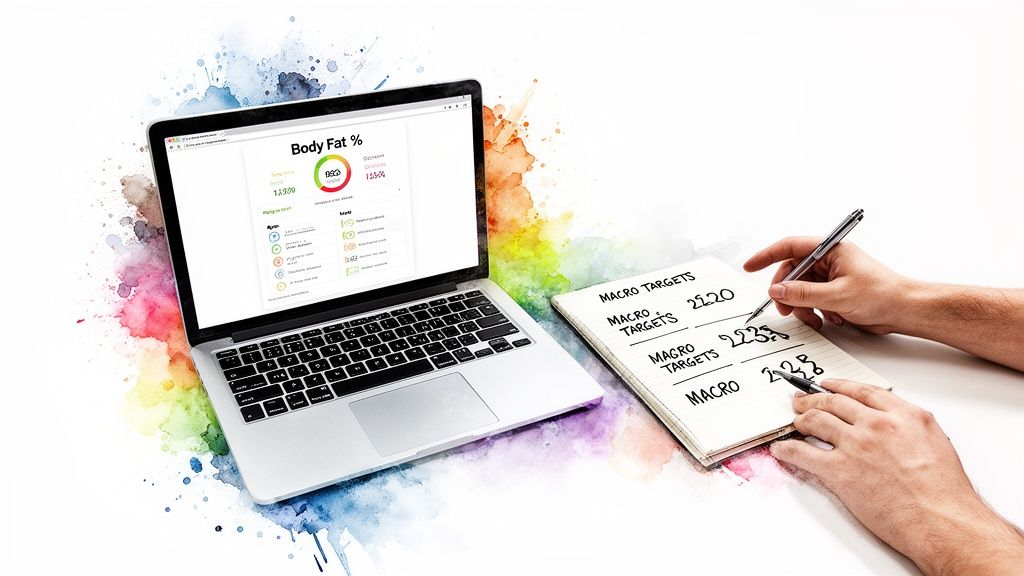
This is where you connect the dots between data and your daily decisions. Whether you're looking to shed fat, build muscle, or just maintain where you are, your body fat percentage is the compass that guides your calorie and macronutrient targets. It turns a vague wish into a concrete, actionable plan.
From Percentage to Protein and Calories
Let's make this real with an example. Imagine a woman who is 5'6", weighs 150 pounds, and her body fat calculator shows she's at 30% body fat. Her goal is to get down to a healthier 25%.
Here’s how she can turn that number into a powerful action plan:
-
Find Her Lean Body Mass (LBM): Your LBM is everything in your body that isn't fat—muscle, bones, water, and organs. Think of it as your metabolic engine.
- Calculation: 150 lbs x (1 - 0.30) = 105 lbs of LBM
-
Set a Protein Target: Protein is your best friend when losing fat because it helps you hold onto that precious muscle. A solid guideline for fat loss is aiming for 1.0 to 1.2 grams of protein per pound of LBM.
- Calculation: 105 lbs LBM x 1.1 g/lb = ~116 grams of protein per day
-
Figure Out Her Calorie Needs: To lose fat, you need to be in a calorie deficit. Her Total Daily Energy Expenditure (TDEE) is the total number of calories her body burns in a day. You can easily find this number using a comprehensive TDEE calculator to set your baseline.
- Example: If her TDEE is 2,000 calories, a moderate deficit of 400-500 calories is a great starting point for sustainable fat loss. This puts her daily target right around 1,500-1,600 calories.
With just these three numbers—LBM, a protein goal, and a calorie target—she now has a clear, personalized nutrition framework built to help her drop fat while keeping her muscle.
Tailoring Macros for Cutting vs. Bulking
Your specific goals will dictate how you split the rest of your calories between carbs and fats. This is another area where knowing your body fat percentage helps you decide which phase you should focus on.
- For Cutting (Fat Loss): The priorities are simple: a calorie deficit and high protein. If you have a higher body fat percentage, you can generally handle a slightly larger deficit without risking muscle loss.
- For Bulking (Muscle Gain): You'll need a modest calorie surplus, typically 250-500 calories above your TDEE. Here, carbs become more important for fueling intense workouts and helping you recover.
To give you a clearer picture, here’s how your macronutrient breakdown might shift depending on your primary goal.
Sample Macro Splits Based on Body Fat Goals
| Fitness Goal | Protein % | Carbohydrate % | Fat % |
|---|---|---|---|
| Fat Loss (Cutting) | **30-40%** | **30-40%** | **20-30%** |
| Muscle Gain (Bulking) | **25-35%** | **40-55%** | **15-25%** |
This table shows typical starting points. For fat loss, protein is kept high to protect muscle, while carbs and fats are balanced. For muscle gain, carbohydrates are prioritized to provide the energy needed for tough training sessions and muscle repair.
Your Long-Term Strategy
Building a plan that actually sticks is about more than just numbers; it's about creating habits that last. For a truly sustainable approach, it's worth exploring different philosophies, like learning how to keep 9% body fat year-round without dieting or counting calories.
Your action plan should also include regular check-ins. Plan to re-calculate your body fat percentage every 4-6 weeks to see how you're progressing. As your body composition changes, your LBM and TDEE will also shift, meaning you’ll need to tweak your calorie and macro targets. This ongoing process ensures your plan evolves with you, keeping you on the fastest and smartest path to your goals.
Common Measurement Mistakes to Avoid
When you're tracking progress, consistency is everything. Using a body fat percentage calculator is an incredible tool for seeing what’s really happening with your body composition, but a few simple mistakes can throw your numbers off and leave you frustrated.
Think of it like taking a progress photo—if the lighting and angle are different every time, you can’t actually tell what’s changed. The goal is to create a repeatable process you can trust. By sidestepping these common pitfalls, you’ll get reliable data that paints a true picture of your progress.
Inconsistent Timing and Conditions
This is the single biggest mistake people make. Your body's hydration levels and food intake cause your weight and circumference measurements to fluctuate like crazy throughout the day. A waist measurement taken right after a big dinner is going to look a lot different than one taken first thing in the morning.
This creates "noise" in your data, making it impossible to know if a change is real progress or just a normal daily variation.
The Fix: Create a strict measurement ritual.
- Always measure at the same time. The gold standard is right after you wake up, after using the restroom, and before eating or drinking anything.
- Wear the same thing (or nothing). This stops your clothes from adding variability to your measurements.
- Use the exact same spots. Be meticulous. Measure the same points on your neck, waist, and hips every single time. A landmark like your belly button for the waist measurement can be a huge help.
This simple routine turns a noisy guess into a reliable trend line.
Obsessing Over Daily Fluctuations
It’s so easy to get discouraged if your body fat percentage ticks up by half a point overnight. But just like with the scale, daily fluctuations are completely normal and don't mean you've gained actual body fat. Things like water retention, bloating, or even a tiny error in your tape measure placement can cause these small shifts.
Chasing daily perfection is a recipe for anxiety. The real value in tracking your body fat percentage is seeing the long-term trend, not the day-to-day blips.
Focus on the weekly or monthly average instead. This smooths out all the daily noise and reveals what’s really happening. It's the best way to see if your hard work is truly paying off without driving yourself crazy.
Using Different Calculators or Methods
Jumping between different online calculators or switching from a tape measure to a BIA scale will give you a headache and a bunch of conflicting results. Each method and formula—like the U.S. Navy versus a BMI-based one—uses a totally different algorithm to estimate your body fat. They aren't meant to be used interchangeably.
Switching your method is like changing the rules of the game halfway through. You completely lose your baseline, making it impossible to compare your new numbers to your old ones.
The key is to pick one reliable method and stick with it. Even if a specific body fat percentage calculator has a small margin of error, using it consistently will still show you the trend of your progress, and that's the most important piece of information you need.
Frequently Asked Questions About Body Fat
When you start digging into body composition, a lot of questions pop up. Here are some of the most common ones we hear, with straightforward answers to clear things up.
How Often Should I Check My Body Fat Percentage?
For tracking that actually means something, aim to measure your body fat percentage every 4 to 6 weeks.
It's tempting to check more often, but daily fluctuations in things like water weight can be seriously misleading. A monthly or bi-monthly check-in gives you a much clearer picture of your real progress. It also allows enough time for the changes from your consistent training and nutrition to actually show up.
Can a Body Fat Calculator Be Wrong?
Yes, absolutely. Any at-home method, especially one using a tape measure, is an estimation. They all come with a margin of error that depends on the specific formula and, more importantly, how precise you are with your measurements.
But here’s the secret: the real power is in consistency. Even if the number itself is off by a few points, using the same calculator and the same measurement process over time will reliably show you the trend. And knowing whether you're successfully losing fat is the most valuable piece of information you can get.
Is It Possible to Be "Skinny Fat"?
Definitely. This is when someone has a "normal" body weight or BMI but carries a high percentage of body fat and low muscle mass. You might look slim in clothes, but your body composition tells a different story.
This is the perfect example of why the number on the scale can be so deceptive. Your body fat percentage gives you the inside scoop on your health and fitness in a way that weight alone never could.
How Does Body Fat Impact My Metabolism?
Your body composition is one of the biggest factors driving your metabolism. Muscle is far more metabolically active than fat, which means it torches calories at a much higher rate, even when you're just sitting on the couch.
So, a person with more lean muscle and less body fat will have a naturally faster resting metabolism than someone of the exact same weight who has more fat. It’s another great reason why building and holding onto muscle is so crucial for long-term health.
Ready to stop guessing and start getting real answers? The Lilbite app has a free, easy-to-use Body Fat Calculator built right in. It’s part of a complete toolkit designed to help you turn your numbers into a smart, actionable nutrition plan. Download Lilbite today and take control of your fitness journey.
Refined using Outrank