Loading...
Weight ManagementPublished 2026-02-15
How to Calculate Calorie Deficit for Sustainable Fat Loss
L
Lilbite Team
Lilbite editorial team

Calculating a calorie deficit is pretty simple on the surface: you just have to eat fewer calories than your body burns every day. This energy gap forces your body to tap into its stored fat for fuel, which is exactly what leads to weight loss.
For most people, aiming for a deficit of 300-500 calories a day is a healthy and effective place to start.
Understanding Calorie Deficit Beyond The Hype
A calorie deficit is the bedrock principle of fat loss, but it's often buried under a mountain of myths and oversimplified "rules." At its heart, it's all about energy balance. Think of your body like a bank account where calories are the currency—when you deposit (eat) less than you withdraw (burn), your balance (stored fat) goes down. Simple as that.

This isn’t some new fad. The famous "3,500 calories equals one pound" rule actually comes from research done way back in 1958 by a physician named Max Wishnofsky. He figured that a 500-calorie daily deficit would result in a one-pound loss per week. And while that formula gave people a straightforward starting point that has stuck around for decades, we now know it's not quite that clean-cut.
Before we dive deeper, let's get the core concepts straight. Understanding these terms makes the whole process of creating a calorie deficit much clearer.
Calorie Deficit At a Glance
| Concept | What It Means | Why It Matters For You |
|---|---|---|
| **Calorie Deficit** | Eating fewer calories than your body burns. | This is the non-negotiable requirement for fat loss. Without it, your body has no reason to use its stored energy (fat). |
| **Energy Balance** | The relationship between calories in (food) and calories out (activity, metabolism). | Your goal is to shift this balance into the negative—a deficit—to trigger weight loss. |
| **BMR** | Basal Metabolic Rate. The calories you burn just by being alive (at rest). | This is the biggest chunk of your daily calorie burn. As you lose weight, your BMR will drop, which is why your calorie target needs to be adjusted over time. |
| **TDEE** | Total Daily Energy Expenditure. Your BMR plus all the calories you burn from daily activities and exercise. | This is the number you need to eat below to create a deficit. It’s your true maintenance level. |
Getting these basics down helps you move past generic advice and start making informed decisions tailored to your own body and goals.
Why a Modern Approach Matters
The problem with the old 3,500-calorie rule is that it treats the body like a simple furnace, failing to account for all the individual factors that change your energy needs. As you lose weight, your Basal Metabolic Rate (BMR)—the calories your body needs just to keep the lights on—naturally goes down. It makes sense, right? There's less of you for your body to maintain.
This is called metabolic adaptation, and it’s the sneaky reason why a static deficit that worked great for the first few weeks can suddenly lead to a frustrating plateau. A truly effective plan needs to be dynamic and adapt right along with you.
Key Takeaway: A successful calorie deficit isn't about chasing a rigid, one-size-fits-all number. It's about understanding your body's real-time energy needs and being ready to adjust your intake as your body changes.
This is where modern tools can be a lifesaver. Instead of just plugging numbers into a decades-old formula, apps like Lilbite use built-in Calorie Deficit Calculators to give you a personalized starting point. More importantly, they help you adjust that target as you make progress, factoring in your changing weight and activity levels to keep your deficit effective.
If you really want to get into the weeds on the principles, our dedicated article on Calorie Deficit For Weight Loss is a great next step.
Ultimately, figuring out your initial calorie deficit is just step one. The real key to seeing it through is using that knowledge to build a flexible, personalized plan that you can actually stick with for the long haul.
Finding Your Personal Calorie Baseline
Before you can even think about creating a calorie deficit, you need to know your starting point. This magic number is your Total Daily Energy Expenditure (TDEE)—basically, the total number of calories your body burns over a 24-hour period. Think of it as your personal energy budget.
To figure out your TDEE, we first need to find its foundation: your Basal Metabolic Rate (BMR). This is the bare-minimum energy your body needs just to keep the lights on—powering your brain, keeping your heart beating, and maintaining your body temperature while you're at complete rest.
Calculating Your Basal Metabolic Rate
One of the most reliable ways to estimate your BMR is with the Harris-Benedict equation. It might sound a bit technical, but it’s just a straightforward formula that uses your weight, height, age, and sex to get a solid estimate of your resting metabolism.
Here’s how the formulas break down:
- For Men: BMR = 66 + (13.7 × weight in kg) + (5 × height in cm) – (6.8 × age)
- For Women: BMR = 655 + (9.6 × weight in kg) + (1.85 × height in cm) – (4.7 × age)
Let's run through a quick example. Imagine Alex, a 35-year-old guy who is 180 cm tall and weighs 85 kg.
BMR = 66 + (13.7 × 85) + (5 × 180) – (6.8 × 35)
BMR = 66 + 1164.5 + 900 – 238
BMR ≈ 1892.5 calories
So, just by existing, Alex's body burns about 1,893 calories a day. That’s before he even gets out of bed.
From BMR To Your Total Daily Calorie Burn
Your BMR is just part of the picture. To get your actual TDEE, you have to factor in all your daily movement—everything from walking the dog to hitting the gym. We do this by multiplying your BMR by an activity factor.
Find the description that best fits your lifestyle:
| Activity Level | Description | Multiplier |
|---|---|---|
| **Sedentary** | Little to no exercise, desk job | BMR x **1.2** |
| **Lightly Active** | Light exercise/sports 1-3 days/week | BMR x **1.375** |
| **Moderately Active** | Moderate exercise/sports 3-5 days/week | BMR x **1.55** |
| **Very Active** | Hard exercise/sports 6-7 days a week | BMR x **1.725** |
Let's stick with our example. Alex has a desk job, but he works out four times a week. That puts him squarely in the "Moderately Active" category.
TDEE = 1892.5 (BMR) × 1.55 (Activity Factor)
TDEE ≈ 2933 calories
Alex’s TDEE—his maintenance calorie number—is around 2,933 calories per day. This is the baseline he needs to know before he can create an effective fat loss plan.
Your TDEE is not set in stone. It's a snapshot of your current energy needs. If your weight changes, you start working out more, or even change jobs, this number will shift right along with you.
Of course, nobody expects you to pull out a calculator every time. Before you can set a deficit, it’s worth taking a moment to understand how to calculate your daily calorie needs properly.
Luckily, modern tools have made all this math obsolete. You can use the Lilbite app to get instant access to a free, professional-grade TDEE calculator. It does all the heavy lifting and gives you a precise baseline in seconds.
Choosing a Deficit Strategy That Works For You
Alright, you’ve done the hard part and figured out your TDEE. Now comes the real question: how big should your calorie deficit actually be?
There’s no magic number here. The best approach is the one that fits your life, your goals, and even your personality. What works for a competitive athlete prepping for a show would be totally unsustainable for a busy parent juggling work and kids.
Let's walk through three solid strategies. The goal is to find a path that leads to lasting results, not a quick burnout.
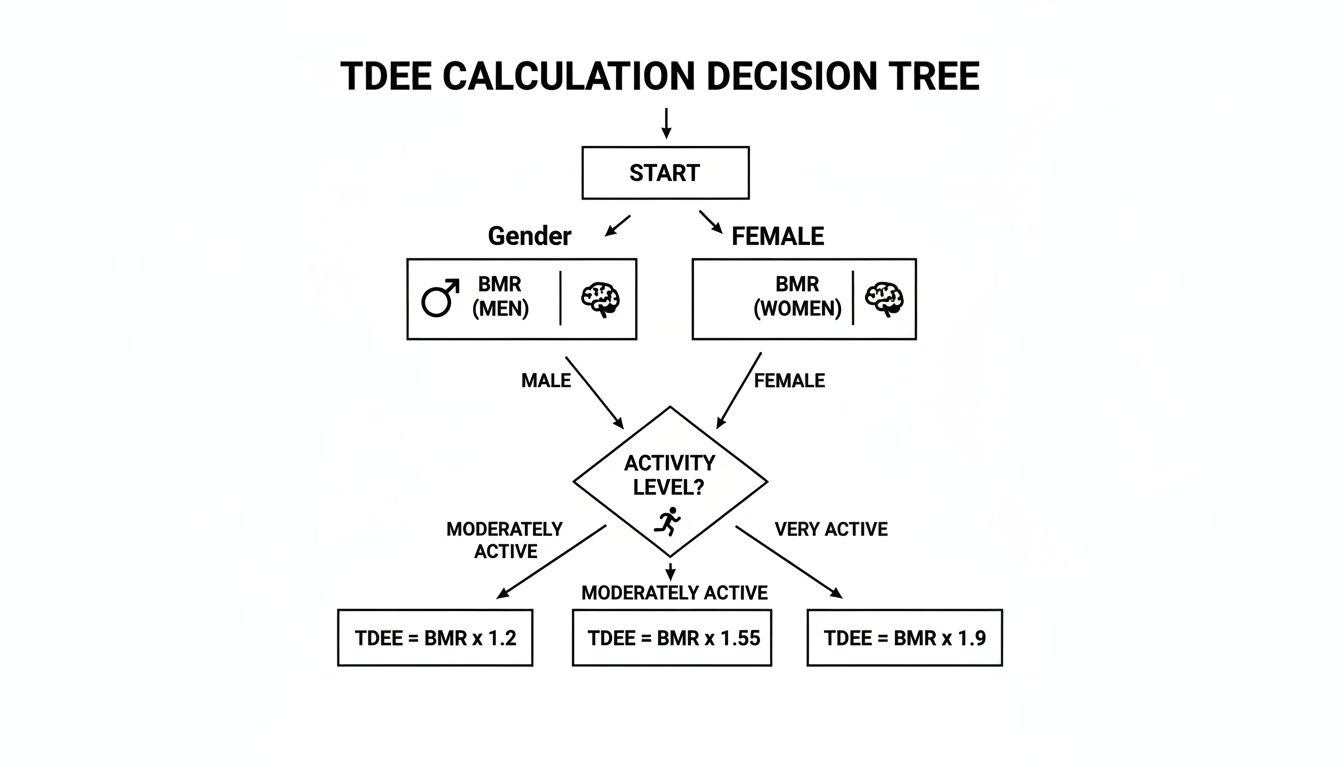
This decision tree gives you a great visual of how things like your gender, weight, and activity level all feed into that final TDEE number—which is the baseline for everything we're about to do.
The Fixed Number Method
This is the most straightforward way to create a deficit. You just subtract a set number of calories from your TDEE every single day. Simple.
- How it works: Subtract 300-500 calories from your daily TDEE.
- Best for: Beginners who want a simple, consistent target. It takes the guesswork out of daily planning.
- Example: If your TDEE is 2,400 calories, your new daily goal would be somewhere between 1,900 and 2,100 calories.
The beauty of this method is its simplicity. You have one number to aim for every day, which is perfect when you're just starting out and trying to build new habits.
The Percentage Method
Here, we get a little more personalized. Instead of a fixed number, you reduce your intake by a set percentage of your TDEE.
This is a fantastic option because the deficit scales with you. A larger person with a higher TDEE will naturally have a larger calorie cut, while a smaller person's deficit will be more moderate and manageable.
- How it works: Reduce your TDEE by 15-25%.
- Best for: Anyone who wants a deficit that’s proportional to their body size and energy output.
- Example: For that same TDEE of 2,400 calories, a 20% deficit is 480 calories (2400 x 0.20). Your new target would be 1,920 calories.
The Rate of Loss Method
This strategy is for the planners out there. It's goal-oriented and focuses on a target rate of weight loss each week. A safe and sustainable pace is usually between 0.5% to 1% of your body weight per week.
A weekly deficit of 3,500 calories roughly translates to one pound of fat loss. This is a super reliable benchmark for setting your daily calorie target based on how much you want to lose each week.
With this method, you decide on your weekly goal first and then work backward to find your daily calorie number.
- How it works:
- To lose 1 pound per week, you need a 3,500-calorie weekly deficit. That breaks down to a 500-calorie deficit each day.
- To lose 0.5 pounds per week, you need a 1,750-calorie weekly deficit, which means a 250-calorie daily deficit.
- Best for: People who are motivated by seeing consistent, predictable progress on the scale.
Which Deficit Method Is Right For You?
Feeling a bit stuck on which path to take? Each one has its pros and cons depending on what you're looking for. This table breaks it down to help you decide.
| Method | How It Works | Best For | Potential Downside |
|---|---|---|---|
| **Fixed Number** | Subtract **300-500 calories** from your TDEE daily. | Beginners; people who love simplicity and a consistent daily target. | Can be too aggressive for smaller individuals or too small for larger ones. |
| **Percentage** | Reduce TDEE by **15-25%**. | A more personalized approach that scales with your body size. | Requires a little extra math upfront. |
| **Rate of Loss** | Set a daily deficit (**500 kcal for 1 lb/wk**) to hit a weekly weight loss goal. | Goal-oriented people who are motivated by predictable outcomes. | Can encourage a focus on the scale rather than overall progress and feelings. |
Ultimately, choosing the right strategy is personal. If you’re just starting out, the Fixed Number method is simple and incredibly effective. If you want something that feels more tailored, the Percentage method is a great choice.
For a deeper dive into setting these numbers and dialing in your nutrition, check out our guide on using a macro calculator for weight loss.
Putting Your Calorie Deficit Into Practice
Alright, you've got your TDEE and you've picked a deficit strategy. That’s the easy part. Now for the real work: actually applying those numbers to what you eat every single day. This is where the magic happens, but let's be honest, it's also where most people get frustrated and give up.
Trying to log food manually is a soul-crushing chore. Weighing every last gram of chicken, scrolling through endless food databases, and adding it all up just sucks the joy out of eating. This friction is exactly why so many people bail on their goals. But thankfully, modern tools have completely changed the game, making the day-to-day tracking almost effortless.
Smart Tracking That Actually Works
Forget the tedious data entry. With an app like Lilbite, you can use features like ‘Snap & Analyze’ to just take a photo of your meal. The AI does the heavy lifting—it identifies the food, estimates the portions, and logs the calories and macros for you. This one feature tears down the biggest wall standing between you and consistency: the sheer effort of logging everything.
This shift from manual labor to smart automation frees you up to focus on your food choices, not the numbers. Tracking becomes a quick, simple habit instead of a task you dread.
The goal isn't just to track calories; it's to build a sustainable system that provides accurate feedback without taking over your life. Technology makes this possible by handling the tedious work for you.
Think about it. You're out at a restaurant, trying to decide between the salmon and the chicken pasta. Instead of just guessing, a quick photo gives you the data to make an informed choice right then and there. It’s about fitting your calorie deficit into your real life, not rearranging your life to fit your deficit.
Turning Data Into Actionable Insights
Hitting your calorie number is one thing, but understanding the quality of those calories is what truly drives results. A 1,800-calorie diet packed with lean protein and fiber is going to feel worlds different from an 1,800-calorie day fueled by processed snacks.
This is where AI-powered tools give you a serious edge. The Lilbite app doesn't just throw numbers at you; it helps you make sense of them. You can use the ‘Talk to AI’ feature to ask the practical questions that pop up all day.
- "Is this meal good for fat loss?"
- "How can I add more protein to this breakfast without blowing up my calorie budget?"
- "What's a good dinner idea to hit my remaining macros?"
This turns your tracker from a boring logbook into your personal nutrition assistant. You get personalized, goal-focused answers that help you learn as you go. The AI can even analyze your meal and give you an instant Nutrition Level score, so you know at a glance how balanced it is.
Ultimately, putting your plan into practice is all about bridging the gap between knowing your target and making the right choices meal after meal. If you ever need to double-check your numbers, our free calorie deficit calculator is always there to get you back on track. By leaning on smart tools, you can make your calorie deficit feel less like a restrictive diet and more like an informed, empowered way of eating.
What To Do When Your Weight Loss Stalls
Hitting a weight loss plateau can feel like running into a brick wall. One week the scale is moving down steadily, and the next, it’s completely stuck. But this isn't a sign you've failed—it's actually a predictable sign of progress. Your body is smart and incredibly adaptive.
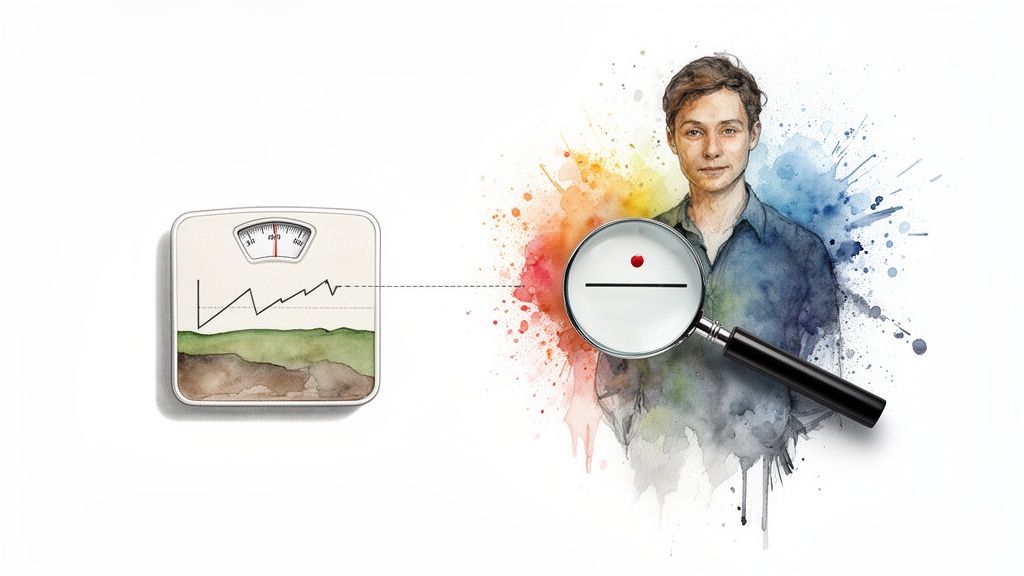
As you lose weight, your Basal Metabolic Rate (BMR) naturally drops because there's simply less of you for your body to maintain. This phenomenon, known as metabolic adaptation, means your original calorie deficit eventually becomes your new maintenance level. What once created weight loss now just keeps you at your current weight.
Recalculate Your TDEE and Adjust Your Deficit
The first and most important move to break through a stall is to get an updated picture of your energy needs. Your TDEE isn't a "set it and forget it" number. It changes right along with your body.
A good rule of thumb I've always followed is to recalculate my TDEE for every 10-15 pounds lost. This is crucial for ensuring your calorie deficit stays effective. For instance, a 200-pound person’s TDEE might be 2,500 calories, but after losing 15 pounds, it could drop to around 2,350. Suddenly, your old 2,000-calorie target is only a tiny 350-calorie deficit, slowing progress to a crawl.
This is where tools like the Lilbite app make life easier. Just update your weight in your profile, and it automatically spits out revised calorie and macro targets. No manual math, no guesswork.
Prioritize Protein to Preserve Muscle
When you're in a calorie deficit, your body doesn't just pull from fat stores; it can also start breaking down precious muscle tissue for energy. Losing muscle is the last thing you want, as it tanks your metabolism even further. The simple solution is to make protein your top priority.
Consuming enough protein sends a powerful signal to your body to hold onto lean muscle mass, even while you're losing weight. This helps ensure that the pounds you drop are coming from fat, not muscle.
I recommend aiming for a daily protein intake between 1.6 to 2.2 grams per kilogram of body weight. This higher intake also crushes hunger, helping you feel fuller on fewer calories while giving your muscles the building blocks they need to stay strong.
Consider a Strategic Diet Break
Sometimes, the best way to move forward is to take a planned step back. A "diet break" involves intentionally bumping your calories back up to your new maintenance level for one to two weeks.
This isn't a free-for-all "cheat week." It’s a strategic tool with some serious benefits:
- Psychological Relief: It gives you a much-needed mental break from the daily grind of dieting, which can do wonders for your motivation and long-term consistency.
- Hormonal Reset: It can help normalize hormones like leptin (which regulates hunger and metabolism) that tend to plummet during a long diet.
This approach gives both your body and your mind a chance to reset, making it much easier to jump back into an effective deficit afterward. This isn't just theory—rigorous studies show that metabolic adaptation is a real hurdle, with BMR dropping 10-20% during prolonged deficits, slowing weight loss more than simple math would suggest. You can dive deeper into the science behind this by reading this comprehensive research.
Common Questions Answered
When you're dialing in a calorie deficit, a few questions always seem to pop up. Let's tackle the most common ones so you can move forward with confidence.
How Often Should I Recalculate My Calorie Deficit?
This is a great question. As you lose weight, your body requires less energy to function, so your original numbers will eventually need a refresh.
A good rule of thumb is to recalculate your TDEE every time you lose 10 to 15 pounds. This adjustment ensures your deficit remains effective and helps you push past frustrating weight loss plateaus.
If you’re using an app like Lilbite, this whole process is automatic. Just update your weight in your profile, and your calorie and macro targets will adjust right along with you, keeping the progress going.
Can I Be In a Calorie Deficit Without Counting Calories?
You absolutely can. Many people successfully lose weight without ever logging a single meal. The strategy here is less about precision and more about building better habits—things like managing portion sizes, choosing whole, minimally processed foods, and moving your body more.
However, the only way to know for sure that you're in a consistent deficit is to track your intake, at least for a little while. This is where tools like Lilbite's 'Snap & Analyze' feature can be a game-changer. It gives you the accuracy of tracking without the soul-crushing boredom of manual data entry.
What Is The Biggest Mistake People Make?
Hands down, the most common pitfall is getting too aggressive. It's tempting to slash calories dramatically, thinking it will speed up results, but this almost always backfires.
A massive deficit can lead to serious muscle loss, nutrient deficiencies, and a tanking metabolism. This not only makes you feel terrible but sets you up for rebound weight gain down the line.
A sustainable deficit of 300-500 calories per day, or about 15-25% below your TDEE, is the sweet spot. This approach encourages true fat loss while preserving the muscle you've worked hard for and keeping your energy levels stable.
Do I Need To Eat Specific "Fat Burning" Foods?
Nope. There's no such thing as a magical food that melts body fat. Sustainable fat loss comes down to one thing: your overall calorie balance.
Certain foods, especially those high in protein and fiber, can give you a slight edge. They keep you feeling fuller for longer and have a higher thermic effect (your body burns more calories just digesting them). But your main focus should always be on building a balanced diet you can actually stick with.
The goal isn't to chase after a short list of "superfoods" but to create an enjoyable eating pattern that fits within your calorie target.
Ready to stop guessing and start seeing real results? Download Lilbite on the App Store and let our AI-powered tools make hitting your goals feel effortless. Get started at https://lilbite.app.